Unity · C# · Puzzle / Visual Novel
Deception
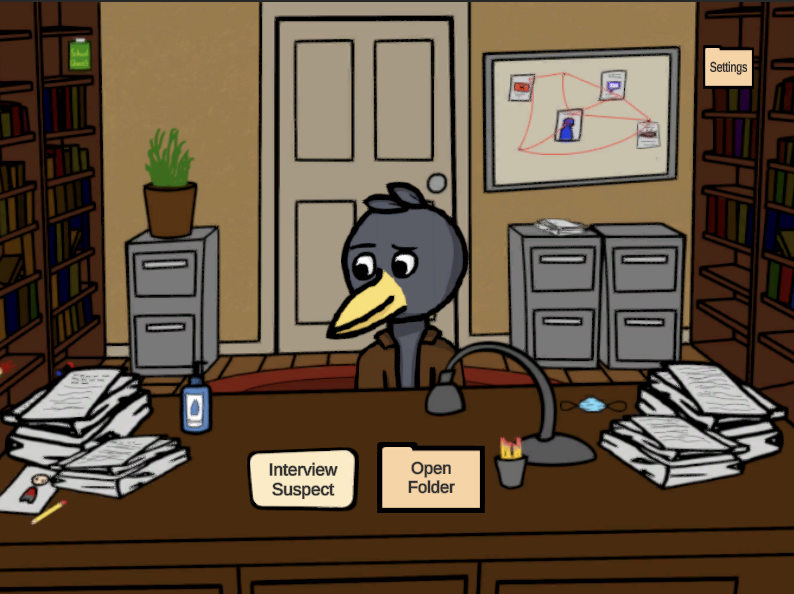
A hand-drawn detective game where players interview possible criminals, evaluate what they learn, and decide whether each suspect should go to prison or remain free.
The Goal
Deception is a small hand-drawn detective game about interviewing possible criminals and deciding whether they should go to prison or remain free. I used the project as an opportunity to own a much wider slice of production than I normally would on a team project.
- Build a compact investigation loop around observation and decision-making.
- Give the game a cohesive hand-drawn identity.
- Integrate programming, environment presentation, music, voices, and sound into one playable experience.
- Ship the game as an HTML5 Unity build that can be played directly in a browser.
Gameplay and Interaction
The core experience is closer to a puzzle/visual-novel investigation than an action game. Players interview suspects, compare what they see and hear, and make a final judgment about whether the person should be imprisoned or released.
- Dialogue-focused suspect interactions.
- Player-facing decision flow built around judging character information.
- UI and scene transitions structured around a short, repeatable investigation loop.
- Designed to work in a browser with minimal control complexity.
Programming and Integration
I led the programming and technical integration for the project in Unity. Because the project was small, that work also meant connecting the narrative flow, scene presentation, audio, and player decisions into a complete build instead of treating each discipline as a separate handoff.
- Unity/C# gameplay implementation.
- Dialogue and decision-state integration.
- UI and scene-flow implementation.
- Audio integration and browser-build support.
Visual and Audio Direction
I also handled environment art, music, and sound design. The public game credits note that the project was created with my sister, while voice work was recorded by me and my mom. That small-team setup meant the final tone depended heavily on keeping the visual and audio decisions consistent with the intentionally playful, handmade presentation.
- Environment art and visual integration.
- Original music and sound design.
- Voice recording and implementation.
- Cross-discipline iteration between code, art, and audio.
Shipping a Small Game
The finished game was released publicly on itch.io as an HTML5 Unity project. Finishing a small game end-to-end was useful because it required decisions about scope, presentation, build reliability, and the parts of a project that are easy to ignore when working only on an isolated system.
- Released and playable in-browser.
- Built with Unity.
- Tagged publicly as a puzzle / visual-novel style experience.
- Kept scope intentionally small enough to reach a finished state.
What I Learned
- Small projects make integration quality more visible because every discipline touches the player experience.
- Owning programming, art, and audio together helped me understand how technical decisions affect tone.
- Shipping a browser build forced me to prioritize scope and reliability over adding unnecessary systems.
- Simple presentation can still feel cohesive when visual, audio, and interaction choices support the same idea.